Machine Learning Types: Hands-On Exercises
Supervised vs Unsupervised & Classification vs Regression
DATA4800 - Artificial Intelligence and Machine Learning
Learning Objectives
- Distinguish between supervised and unsupervised learning scenarios
- Identify when to use classification vs regression approaches
- Apply the decision framework to real business problems
- Analyze datasets to determine the appropriate ML approach
Instructions: For each scenario below, identify:
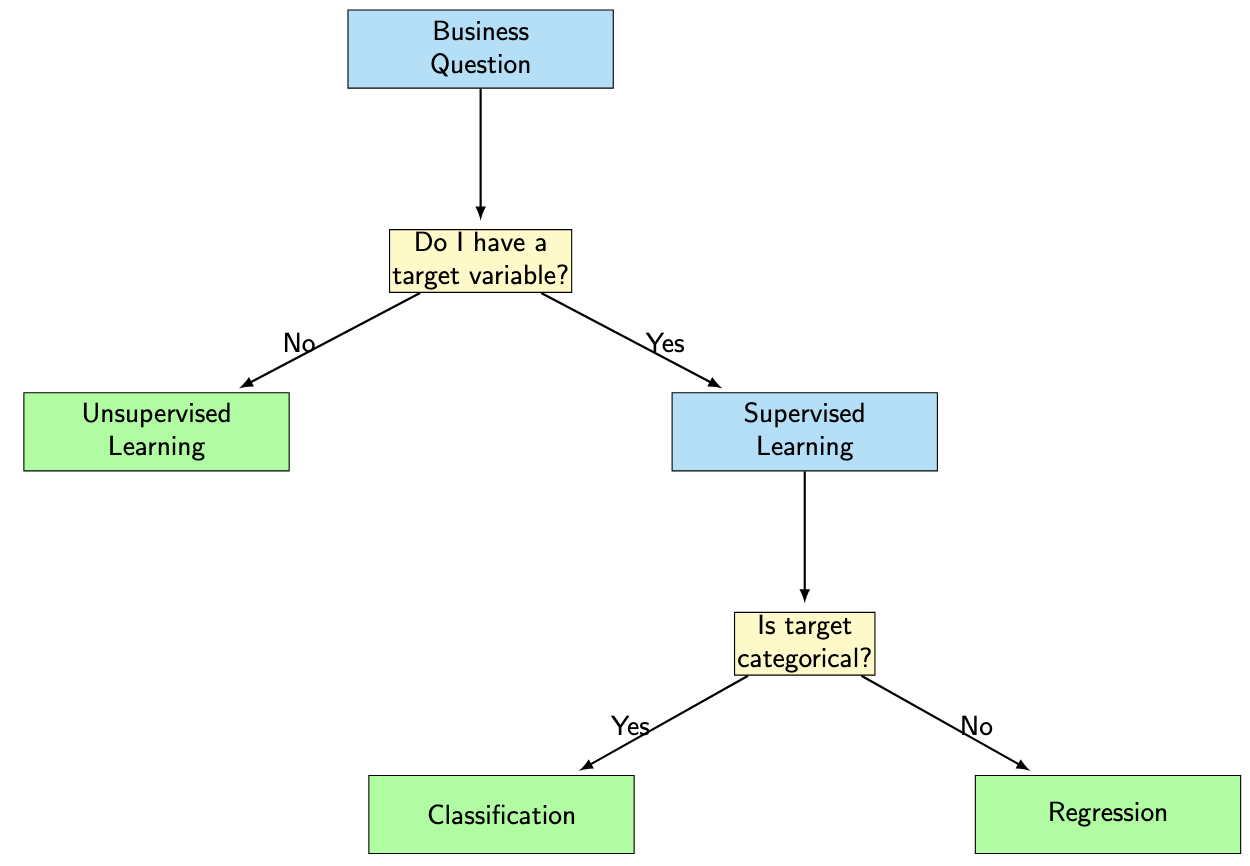
- Is this supervised or unsupervised learning?
- If supervised, is it classification or regression?
Scenario 1.1
A bank wants to automatically approve or reject loan applications based on applicant's credit score, income, and employment history. They have 10,000 historical applications with known outcomes.
Scenario 1.2
An e-commerce company wants to understand different types of customers based on their browsing behavior, purchase patterns, and demographics. They don't know what customer groups exist.
Scenario 1.3
A real estate company wants to estimate the selling price of houses based on size, location, age, and number of bedrooms. They have sales data from the past 5 years.
Instructions: You will use existing data to make predictions about new cases using simple rules. No complex algorithms needed - just logical thinking!
🎯 Example: How to Make Rule-Based Decisions
Sample Data - Student Grade Prediction:
| Student | Study Hours | Attendance % | Previous Test | Final Grade |
|---|---|---|---|---|
| Alice | 8 | 95% | 85 | A |
| Bob | 3 | 70% | 60 | C |
| Carol | 6 | 88% | 78 | B |
| David | 2 | 60% | 45 | D |
Example Rules I can create:
- Rule 1: If Study Hours ≥ 7 AND Attendance ≥ 90% → Grade A
- Rule 2: If Study Hours ≤ 3 AND Previous Test ≤ 60 → Grade C or D
- Rule 3: If Study Hours = 5-6 AND Attendance ≥ 80% → Grade B
New Student to Predict: Emma: 7 Study Hours, 92% Attendance, Previous Test: 82
My Prediction: Grade A (because she meets Rule 1: Study Hours ≥ 7 AND Attendance ≥ 90%)
Dataset 2.1: Sales Performance Classification
Business Goal: Predict whether a new product will have High, Medium, or Low sales performance.
| Product ID | Season | Marketing Spend | Price | Competitor Price | Sales Performance |
|---|---|---|---|---|---|
| P001 | Summer | $5,000 | $29.99 | $34.99 | Medium |
| P002 | Winter | $8,000 | $49.99 | $45.99 | Low |
| P003 | Fall | $3,000 | $19.99 | $22.99 | High |
| P004 | Spring | $6,000 | $39.99 | $41.99 | Medium |
| P005 | Summer | $7,500 | $24.99 | $28.99 | High |
| P006 | Winter | $2,000 | $59.99 | $55.99 | Low |
NEW PRODUCT: P007 - Season: Spring, Marketing: $4,500, Price: $34.99, Competitor Price: $38.99
Dataset 2.2: Customer Segmentation
Business Goal: Group customers into 2 types and predict which group a new customer belongs to.
| Customer ID | Age | Income | Purchases/Year | Time on Site |
|---|---|---|---|---|
| C001 | 25 | $45,000 | 12 | 15 min |
| C002 | 34 | $75,000 | 8 | 22 min |
| C003 | 19 | $25,000 | 3 | 5 min |
| C004 | 42 | $95,000 | 15 | 18 min |
| C005 | 28 | $55,000 | 6 | 8 min |
NEW CUSTOMER: C006 - Age: 38, Income: $68,000, Purchases/Year: 11, Time on Site: 20 min
Dataset 2.3: Email Classification
Business Goal: Predict the category of a new email.
| Email ID | Contains "Free"? | Contains "Click"? | From Known Sender? | Category |
|---|---|---|---|---|
| E001 | Yes | Yes | No | Spam |
| E002 | No | No | Yes | Important |
| E003 | Yes | No | Yes | Promotional |
| E004 | No | Yes | No | Spam |
| E005 | No | No | Yes | Important |
| E006 | Yes | Yes | Yes | Promotional |
NEW EMAIL: E007 - Contains "Free": No, Contains "Click": Yes, From Known Sender: Yes
Decision Framework
Scenario 3.1: Healthcare Analytics
A hospital wants to improve patient care and operational efficiency. They have patient data including demographics, medical history, treatment costs, length of stay, and patient satisfaction scores.
Multiple Questions to Explore:
- "What types of patients do we treat?" (Unknown patient groups)
- "Will this patient be readmitted within 30 days?" (Yes/No)
- "How much will this patient's treatment cost?" (Dollar amount)